Clinton County is as flat as Indiana gets, and that one fact decides almost every dirt work job in it. Frankfort sits in the middle, the small towns ring it, and between them lies some of the most productive crop ground in the state. Flat ground grows corn and it also holds water, so nearly everything we do here is a conversation about where the water is supposed to go.
The county sits on the Tipton Till Plain, and the unconsolidated material under it runs from roughly a hundred feet thick in the southwest corner to over four hundred in the southeast. What that means at the surface is deep, dark, heavy silt loams: Mahalasville, Starks, Fincastle, Crosby, Martinsville. These are excellent soils and difficult soils at the same time. They hold nutrients and they hold water, and the entire agricultural history of this county is the story of draining them.
That history is why tile work never stops here. Some of the drainage in this ground is older than anybody farming it, clay tile laid by hand generations back that is now collapsing a run at a time and showing up as a wet spot that was not there five years ago. Pattern tile on new spacing, replacing failed mains, blowing out and repairing outlets, and grassed waterways where even flat ground finds a way to cut. If a yield map shows the same drowned-out hole every year, the answer is under the surface, not on it.
The county drains two directions. The north and center feed the Middle and South Forks of Wildcat Creek, with active watershed planning work running in the South Fork, while the southern townships around Kirklin and Colfax drain toward Sugar Creek instead. Practically speaking that means the county surveyor and the regulated drain system matter here more than in the hill counties. Big Cicero is carried by a joint drainage board rather than by one county alone, so a tie-in on that side of Clinton can involve more than one surveyor's office. We settle that before quoting, not halfway through.
Around the towns the work turns residential. Frankfort has plenty of older housing stock where the grade has settled toward the foundation over decades, and Rossville, Mulberry, Michigantown, Kirklin, Colfax and Forest each have the same handful of jobs waiting: a yard that ponds, a lane that has lost its base, a barn pad, a downspout dumping four thousand gallons a year at a corner of the house. None of these are big enough for a Lafayette or Indianapolis outfit to drive out for. They are exactly what we built this company to do.
One honest note about flat country. Grading here is a game of inches, not feet, because there is very little natural fall to work with. Fixing a wet yard in Clinton County usually means finding somewhere for the water to legally go and building a path to it with real, measured fall, not just pushing dirt around until it looks level. That takes instruments and patience. It is also why the cheap version fails here faster than anywhere else in the state.
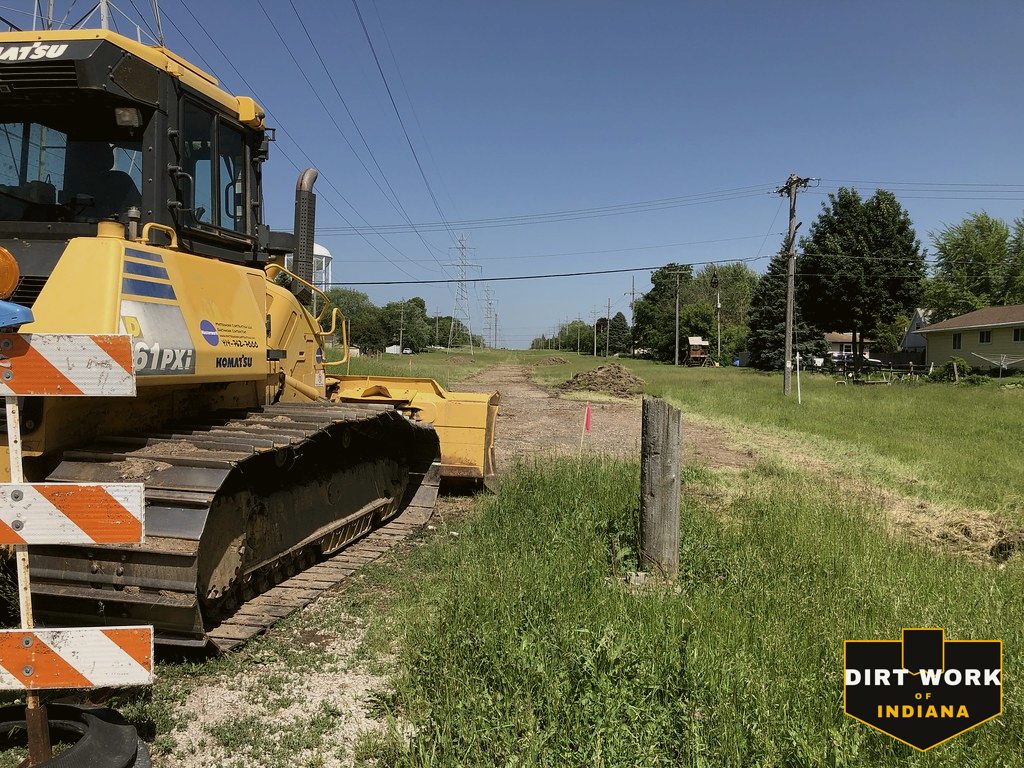
Every service, county-wide
Common Clinton County projects
Field tile and failed-main replacement, grassed waterways, yard drainage and regrades where there is almost no natural fall, gravel farm lanes, pole barn pads, and outlet and ditch cleanup tied into the regulated drain system.