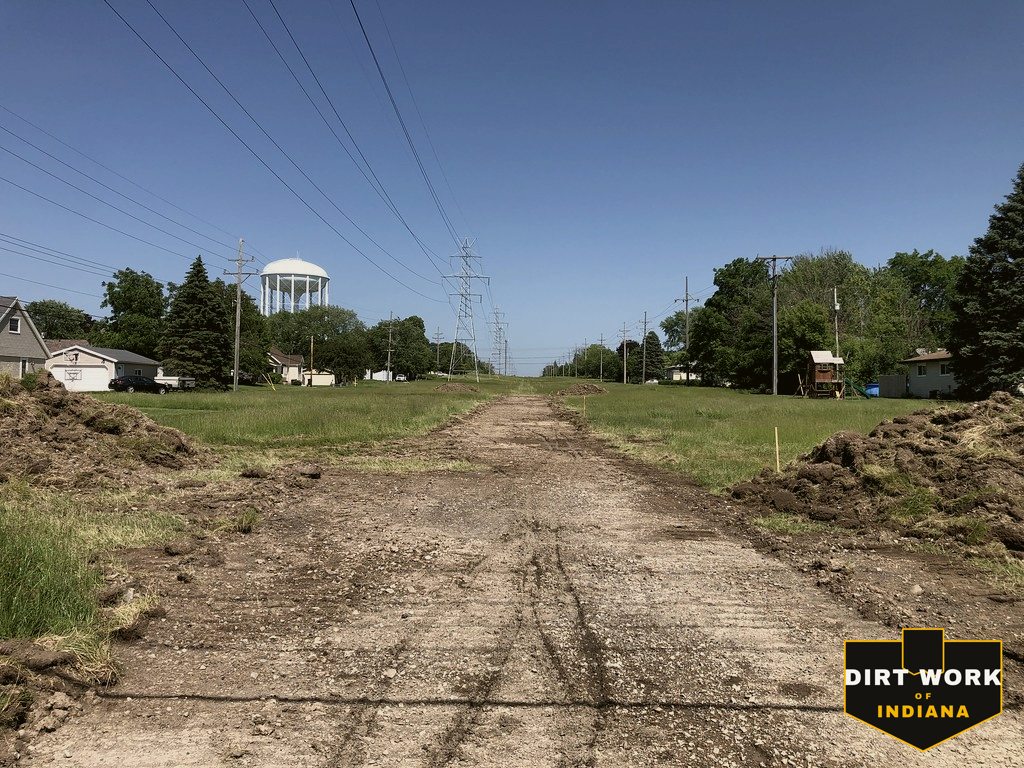
Pole barn and post-frame pads, start to finish
The classic Indiana project, and the one most often done fast instead of right. The sequence does not change much from county to county. Topsoil comes off first and gets stockpiled, because it is worth keeping and because it is the worst thing to build on. Then the footprint is cut down until the machine finds firm, undisturbed ground, and anything soft, wet or organic under it comes out rather than getting buried. From there the pad is built back up in thin, compacted lifts of suitable fill rather than one thick dump, the edges are carried out past the building line so the posts and the eventual slab are not sitting on a crumbling shoulder, and the top is finished with stone so posts set true and a floor pours flat. Talk to us before you order the building. Pad-first scheduling saves money, because the cheapest time to fix a wet corner is before a building company has a crew sitting in your driveway.
Post-frame homes are a different job than pole barns
A barn pad and a house pad can look identical from the road, and they are not the same job. Once people are going to live on it, the pad is structural: it carries a slab, a frost-protected foundation or footings that somebody engineered, plumbing that has to stay where it was set, and a building department that will want to see the work. That means the builder's or engineer's specification governs, compaction is something you document rather than eyeball, and soil testing comes into it whenever the design calls for it. We coordinate with the builder before the first bucket goes in, so the pad matches what the plans assume, and we will tell you plainly if the ground you picked for the house is the wettest spot on the property. A post-frame home on a pad built to barn standards is how good projects end up with cracked floors and doors that will not close.
Why pads fail, and the four mistakes behind most of it
The pads we get called back to fix almost always fail for one of four reasons. Organic material was left in the bottom, so the pad keeps settling for years as it rots and compresses. The fill went in all at once, so the top looks solid and the middle never compacted. The pad was built on ground that was wet at the time, which locks water and soft material under the stone. Or the finished grade does not shed water, so every rain soaks the edge of the pad and the building sits in a puddle of its own making. None of these show up the week the building goes up. They show up the second spring, when the posts lean and the slab cracks, and by then the fix means working around a building instead of an open field.
How high the pad sits, and where the water goes
High enough that water never wins. That usually means the finished pad sits above the surrounding ground with the fall shaped away from the building in every direction, and the water that leaves the pad has somewhere to go that is not your neighbor's yard or your own lane. Downspouts on a big post-frame roof move a surprising amount of water, so where it lands is part of the pad design, not an afterthought. Indiana ground is also full of old field tile, much of it undocumented, and a pad cut across a working tile line is both a drainage problem and a legal one. When a tile turns up we repair or reroute it properly instead of crushing it and covering it, because a broken tile under a new pad is a wet pad waiting to happen.
Northwest Indiana, honestly stated
A good share of our pad calls now come from Porter, Lake and LaPorte counties, and the ground up there changes faster than anywhere else we work. South of the moraine, on the Kankakee lowland around Kingsbury and Hanna in LaPorte County and across southern Porter County, the surface is often muck over sand, the water table sits close to the top for much of the year, and a pad means undercutting the organic material and building back in compacted lifts, with dewatering as the working assumption rather than the exception. Muck depth varies a lot over short distances, and drained muck keeps settling for years, so the depth of the undercut is the most important number on the quote. On the moraine clay around Valparaiso, Chesterton and Crown Point the problem flips: the ground is heavy, sticky and slow to drain, water perches on a dense layer a couple of feet down, and timing the work for dry ground matters as much as the method. Parts of LaPorte County sit on sandy loam over sand and gravel that digs clean and drains on its own, which is the easy version of this job. Snowfall also runs far heavier at La Porte than at Crown Point, about thirty-five miles west, so the winter working window up there is genuinely narrower. We keep no crew parked in Valparaiso or La Porte and will not pretend otherwise. What we do is take the call, quote it straight including what the drive means for scheduling, and send a vetted operator who knows that ground to the job.
Permits and paperwork that touch a pad
Most of what bites people on a pad job is paperwork they did not know existed. If the project disturbs an acre or more of ground, Indiana's construction stormwater general permit applies, and the state is explicit that the farm exemption does not cover barns and outbuildings, so a big pole barn with its lane and turnaround can land inside the permit even on a working farm. If the site sits near a county legal drain, Indiana law gives the county a right of entry along it, commonly seventy-five feet from the top of each bank of an open ditch or either side of a tile, narrower on some newer and urban drains, and permanent structures cannot go in that strip without the board's written consent. State law also requires a call to Indiana 811 at least two full working days before any digging, so buried utilities get marked first. Local building permits and setback rules for barns and homes vary by county and township. We flag all of it while quoting, so it is on the schedule instead of in the middle of it.
Shop, garage, equipment and grain bin pads
Shops and equipment buildings need the same pad discipline plus the parts that keep them usable in February: aprons, approaches and a lane that does not turn into an island of mud. Grain bins are less forgiving still. They need flat, uniform, well-drained support under a heavy and very concentrated load, and the lanes serving them carry loaded trucks. We build pads that keep augers turning and grain dry, and we tie the lane and the turnaround into the same grading plan so the water from one does not end up under the other.
When the pad should go in
Before the building is scheduled, with time for the pad to prove itself through weather when the design allows it. The earlier the call, the more room there is to build on dry ground instead of whatever ground happens to be available the week before the building crew shows up. If your building is already scheduled, call anyway. We will tell you honestly whether the date is realistic for the ground you have, and if it is not, what it would take to make it work.